On October 21, part of Punta Paraíso gave way to the sea at San Pancho. Two weeks earlier, a federal court in Mexico City had ruled that two of its three towers must come down, because they stand on land that belongs to the Nation. The sea and the court reached the same verdict 14 days apart.
The people I keep thinking about are the owners. The warning signs were public for years. Somebody sold them those units. Somebody was supposed to read the paperwork on their behalf.
That is what this post is about. A real estate agent and a real estate advisor are not the same job with a different title.
The short version
An agent works for the sale. An advisor works for your decision. They can hold the same license and show you the same condo. The difference shows up the moment something inconvenient appears.
The pattern has been measured. Agents selling their own homes held out for about 3.7% more and waited about 9.5 days longer than when selling for clients. The gap grew wherever the agent knew more than the client.
Foreign buyers in Mexico sit at the widest information gap there is. The language, the law, and a coastline that doesn't work like home.
At Punta Paraíso, the warning signs were public record for years. Reading them required no inside access. It required someone whose job was to look.
Choose who reads the paperwork before you choose the property.
If you are looking at pre-construction, start with the three questions I ask before I show any project to a client.
Same license, different job
An agent works for the sale. An advisor works for your decision. Both can work in the same office, hold the same license and walk you through the same unit.
Here is something most foreign buyers don't know. In Mexico, the seller pays the commission, including the share that goes to the buyer's agent. When I represent a buyer, my fee comes from the seller at closing. Every agent on the buy side, me included, is paid only if a sale happens.
So the incentive is identical. What differs is what someone does inside it. For a sales agent, every finding that slows the deal is a cost, so the instinct is to explain it away, pass it to the developer, or not look. An advisor goes looking anyway, because the finding that stops a sale can be the most valuable thing a client receives.
This is not a Vallarta problem or a Mexico problem. It is how commission sales are structured in Miami, Toronto, London and Mexico City. Most agents are not bad people. They are doing the job they are paid to do. The question is whether it is the job you need done.
When you are buying in a country whose contracts you cannot read, the person beside you is the whole safety net.
What it means for you: before you judge the property, find out which job the person showing it to you is doing.
The pattern has been measured
Economists have put numbers on it. Steven Levitt and Chad Syverson studied about 98,000 home sales in suburban Chicago, roughly 3,300 of them owned by agents. When agents sold their own homes, they got about 3.7% more and stayed on the market about 9.5 days longer, after controlling for the house itself (NBER, Levitt and Syverson).
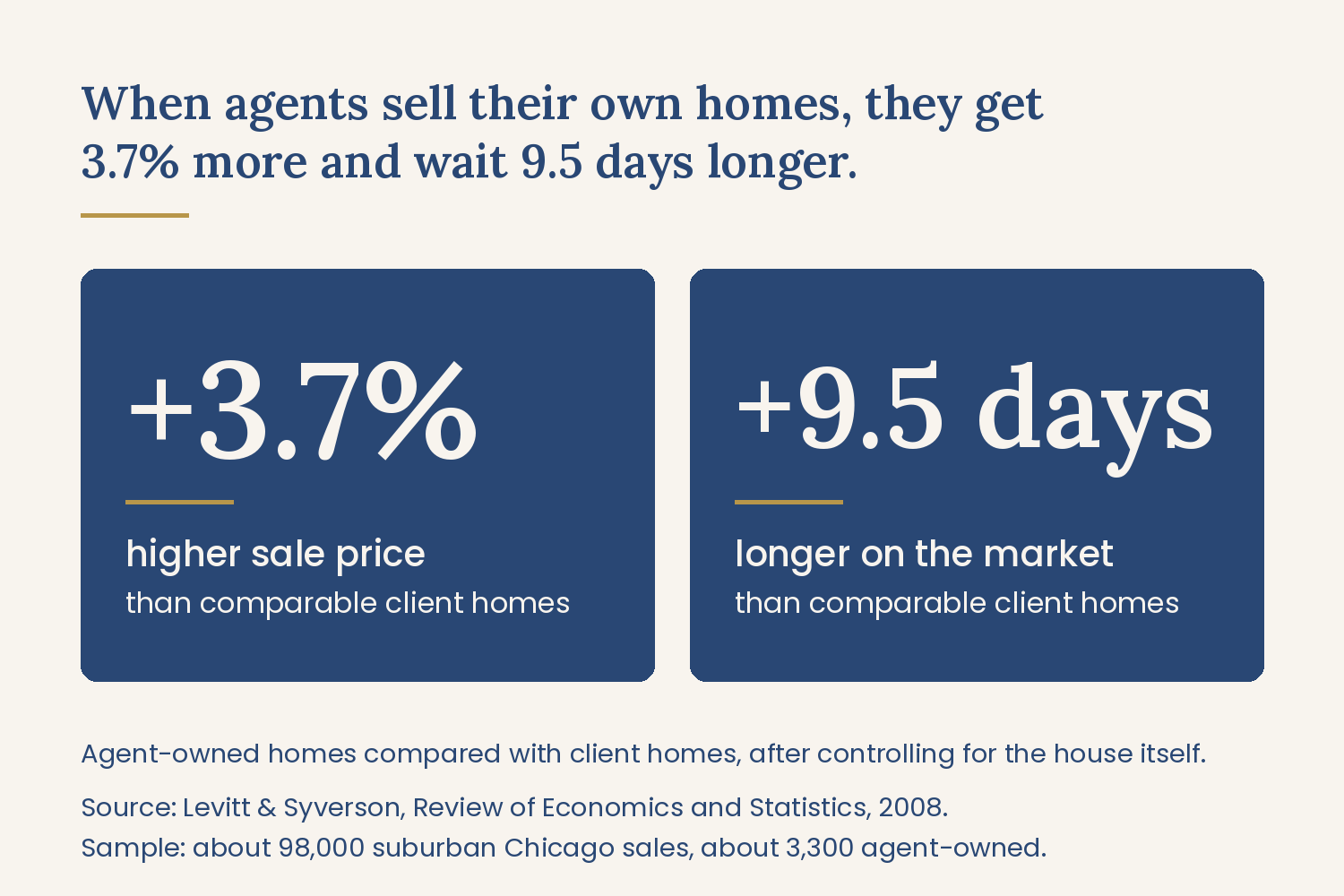
Show the math: on a $500,000 home, 3.7% is $18,500. That is the gap between how patiently an agent sells for themselves and how quickly they sell for a client.
The finding that matters most here is that the distortion grew where the agent's information advantage was largest. The study looked at sellers. The mechanism is the same when you buy: an expert who is paid only when a deal closes and who knows more than you do.
Now picture the widest information gap in real estate. A buyer from Seattle or Toronto. A contract in Spanish. A legal system they have never used. That describes almost every foreign buyer on Banderas Bay. It is also why I publish what buyers actually paid, not what sellers asked, every quarter. Closing that gap is the job.
What it means for you: the less you know about a market, the more the incentives of the person guiding you decide the outcome.
Punta Paraíso: the signs were public for years
Nearly every warning about Punta Paraíso was public record years before the final ruling. None of it required insider access.
| When | What was public |
|---|---|
| 2018 | Nayarit's state congress asked federal authorities to review and suspend the project (source) |
| Aug 2022 | PROFEPA, the federal environmental enforcement agency, ordered demolition (24 Horas) |
| Oct 7, 2026 | Federal court denies the developer's final amparo (constitutional appeal) (La Jornada) |
| Oct 21, 2026 | Part of the structure collapses after weeks of surf and erosion (Meganoticias) |
In plain terms: in Mexico, the first 66 feet (20 m) of firm land past the beach is the zona federal marítimo terrestre, the federal coastal strip (Ley General de Bienes Nacionales, Art. 119). It belongs to the Nation. Nobody can buy or sell it. A developer can hold a concession, a permit to use it under conditions, but the buyers never own it. Riverbanks near the sea carry the same rule.
If you have bought on a US coastline, the instinct is that a beachfront deed is a beachfront deed. Here it is not.
None of this is new. The federal coastal strip has been in Mexican law for decades. Any agent with basic training in Mexican real estate knows it exists. When a building on federal land ends up in court, the explanation that usually follows is that the developer said it was permitted. An advisor's job is never to stop at that sentence.
Who this costs: the owner who trusted the brochure and now holds a unit in a building a court has ordered demolished.
What it means for you: wherever you buy, by the sand, a river or a hillside, ask where the federal line runs before you fall for the view.
The same questions, two different answers
Most buyers never ask about concessions or federal proceedings, because they don't know those words exist. They ask the questions below. The answers tell you which job the person in front of you is doing.
| What you ask | A sales-led answer | An advisory answer |
|---|---|---|
| "Is this building fully legal?" | "It has a deed and the developer has permits." | Asks which permits, for what was actually built, and checks the land beneath it. |
| "Why is this unit priced below the others?" | "Motivated seller. Great deal." | Asks what the market knows that you don't: a dispute, a proceeding, thin resales. |
| "The neighbours seem upset about something. Should I worry?" | "Local politics. Every project has it." | Treats years of documented opposition as a risk with a price. |
| "What happens if something goes wrong after I buy?" | "That won't happen." | Reviews title insurance, your fideicomiso (the bank trust) and the seller's ability to answer for problems. |
| "Can I trust what the developer told me?" | Repeats it. | Asks for it in writing, then verifies it independently. |
Advice does not always mean no. This year I worked with a buyer who wanted a unit in a pre-construction project facing a legal challenge. He knew about the challenge and wanted the unit anyway. That was his decision to make.
My job was to make sure he made it with his eyes open. He had independent legal counsel before and during the negotiation. We built a financial structure that protected him and still worked for the developer. The offer was accepted.
Certainty is not optimism. Sometimes it means telling a client the view is extraordinary and the paperwork is not. Sometimes it means finding the structure that lets them say yes and still sleep in the home they chose.
What it means for you: a good advisor doesn't decide for you. They make sure the decision you make is one you can live with.
Four questions that show you which one you hired
Ask these of anyone you are considering working with, in Vallarta or anywhere else. Watch the pause before each answer.
"What would make you tell me not to buy this?" An advisor has an answer ready. A salesperson has to think about it.
"Who reviews the legal documents, and who do they work for?" You want counsel independent of the developer.
"How are you paid if I walk away?" In Mexico, the true answer is "not at all," because the seller pays at closing. What matters is what they say next: whether they would still tell you to walk.
"What did you check that isn't in the brochure?" Specifics are the proof of work.
These questions test the person. If you are weighing a pre-construction project, the questions that test the project itself are in The Three Questions Most Pre-Construction Buyers Skip. The rest of how I work on the buy side is here.
What it means for you: you can test an agent in ten minutes, long before you test a contract.
What I would tell a client
If you are comparing two agents, ask both what would make them tell you not to buy. The pause tells you which job they have.
If the property sits near the sand or a river, ask for the survey showing the federal line before you fall for the view.
If a project carries a legal challenge and you still want in, that can be a sound decision. Make it with your own attorney, in writing, with a structure that protects you if the worst case arrives.
If anyone tells you "the developer confirmed it," ask for the document.
Most agents need you to decide. I need you to be certain.
If the paperwork behind a view has been on your mind, you know where to find me.
Paradise isn't found — it's negotiated.
Questions buyers ask
What is the difference between a real estate agent and a real estate advisor?
Both may hold the same license, and in Mexico both are usually paid by the seller at closing. The difference is the job. A sales agent works to close the transaction. An advisor works on the quality of your decision, which includes finding reasons to renegotiate, restructure or walk away, even when that costs them the fee.
Can foreigners own beachfront property in Mexico?
Yes. Near the coast, foreign buyers typically hold property through a fideicomiso, a bank trust. But the first 66 feet (20 m) of firm land past the beach is federal land and cannot be owned by anyone. A building on it can be ordered removed regardless of what the buyer paid.
What is the federal zone (ZOFEMAT) in Mexico?
The zona federal marítimo terrestre is a strip of 66 feet (20 m) of firm land beside the beach and along riverbanks near the sea. It belongs to the Nation. Developers can receive concessions to use it under conditions, but it is never sold, and permanent buildings on it are a serious legal risk.
What happened at Punta Paraíso in San Pancho?
A federal court confirmed on October 7, 2026 that two of the complex's three towers must be demolished for occupying federal coastal land. The order traces to a 2022 PROFEPA resolution. On October 21, part of the structure collapsed after weeks of heavy surf and erosion.
What should I ask an agent before buying in Puerto Vallarta?
Start with four questions. What would make you tell me not to buy? Who reviews the legal documents, and who do they work for? How are you paid if I walk away? What did you check that isn't in the brochure? Specific, ready answers point to an advisor.
A note on the data
The agent-incentive figures come from Levitt and Syverson, Review of Economics and Statistics (2008): about 98,000 suburban Chicago sales, Multiple Listing Service of Northern Illinois, roughly 3,300 of them agent-owned. It is US data on sellers. I apply its mechanism to buyers as my own interpretation. The Punta Paraíso facts come from press reports and public records as of October 21, 2026, and are linked above. This post is general information, not legal advice.