The Banderas Bay closings report. Published the first Tuesday after every quarter. What buyers paid, not what sellers asked.
Sellers in Banderas Bay are asking for money buyers are not paying. Every quarter I go through every closed sale on the MLS to show you the gap, in plain numbers.
Between July 1 and September 30, 2026, the Vallarta-Nayarit MLS recorded 265 closed residential sales in the Banderas Bay region, worth about $148 million: 154 resale condos, 41 pre-construction condos and 70 houses.
The 30-second version
Fewer sales, firmer prices. Even counting only July and August, sales ran about 13% below last quarter's pace. Price per square meter still rose in every segment.
A house gets you 80 more square meters for the same $400,000. Houses closed at 58% of the condo price per meter.
Pre-construction is still not cheaper. It closed $9 per square meter below resale. That is the same price.
The first asking price is an opening position. The typical house sold $34,500 below its first price.
Above $1.5 million, houses give more ground than condos. On a typical sale at that level, about $160,000 more.
New to terms like median or price per square meter? Four short definitions sit at the end of this report.
Last quarter I said. Here is what happened.
A report is only worth waiting for if it checks its own calls. Two of last quarter's four held cleanly. Two held in direction but softened.
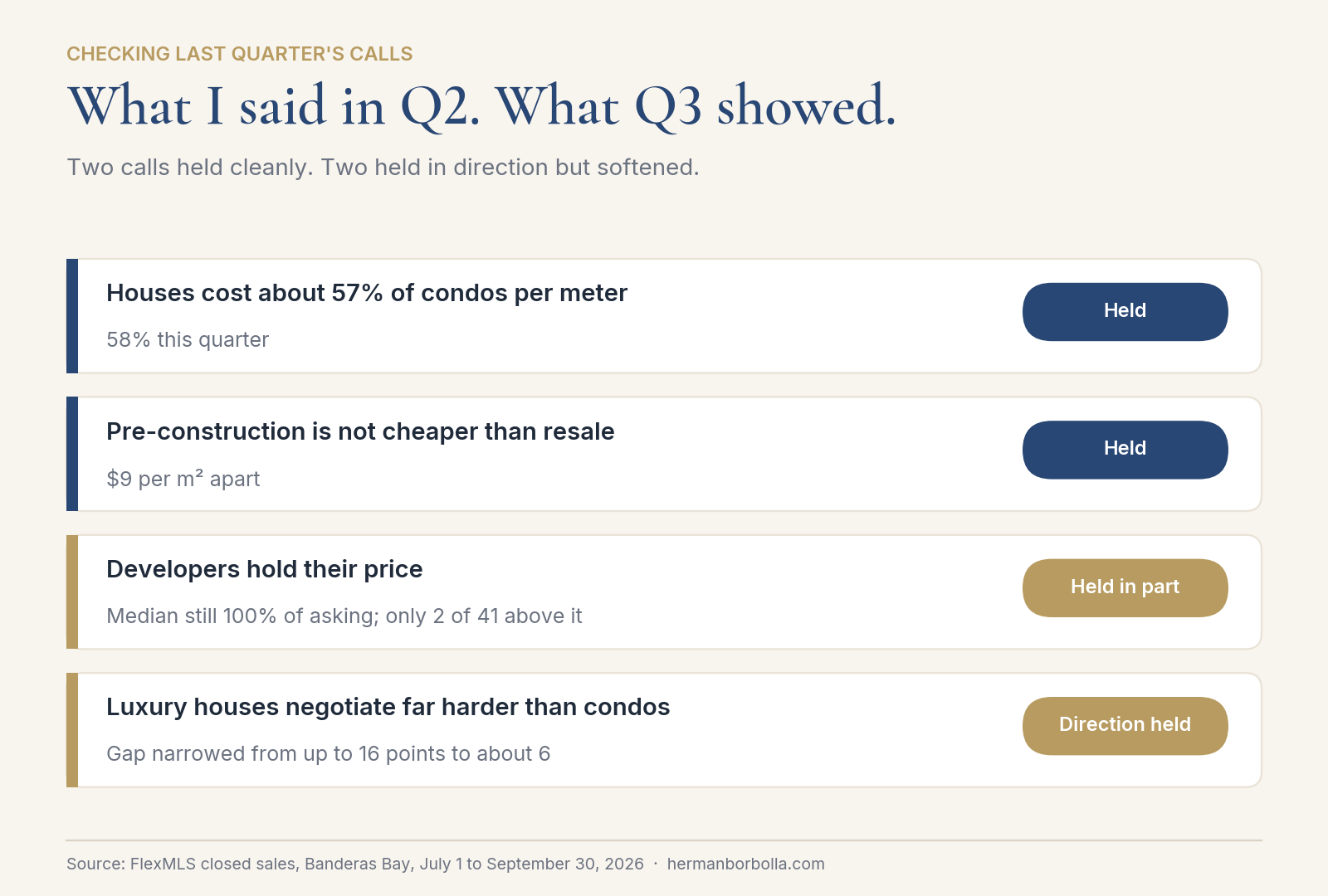
What changed this quarter: fewer sales, firmer prices
Last quarter's report counted 340 sales worth $174 million. This quarter: 265 sales worth $148 million. Part of that drop is not real. Closings reach the MLS late, and September shows only 60 sales against 114 in July.
So I compared only July and August. That ran at about 3.3 sales a day, against 3.8 a day last quarter. About 13% slower. Summer is also our quietest season, and pre-construction closings fell hardest, from 76 to 41.
Prices did not follow volume down:
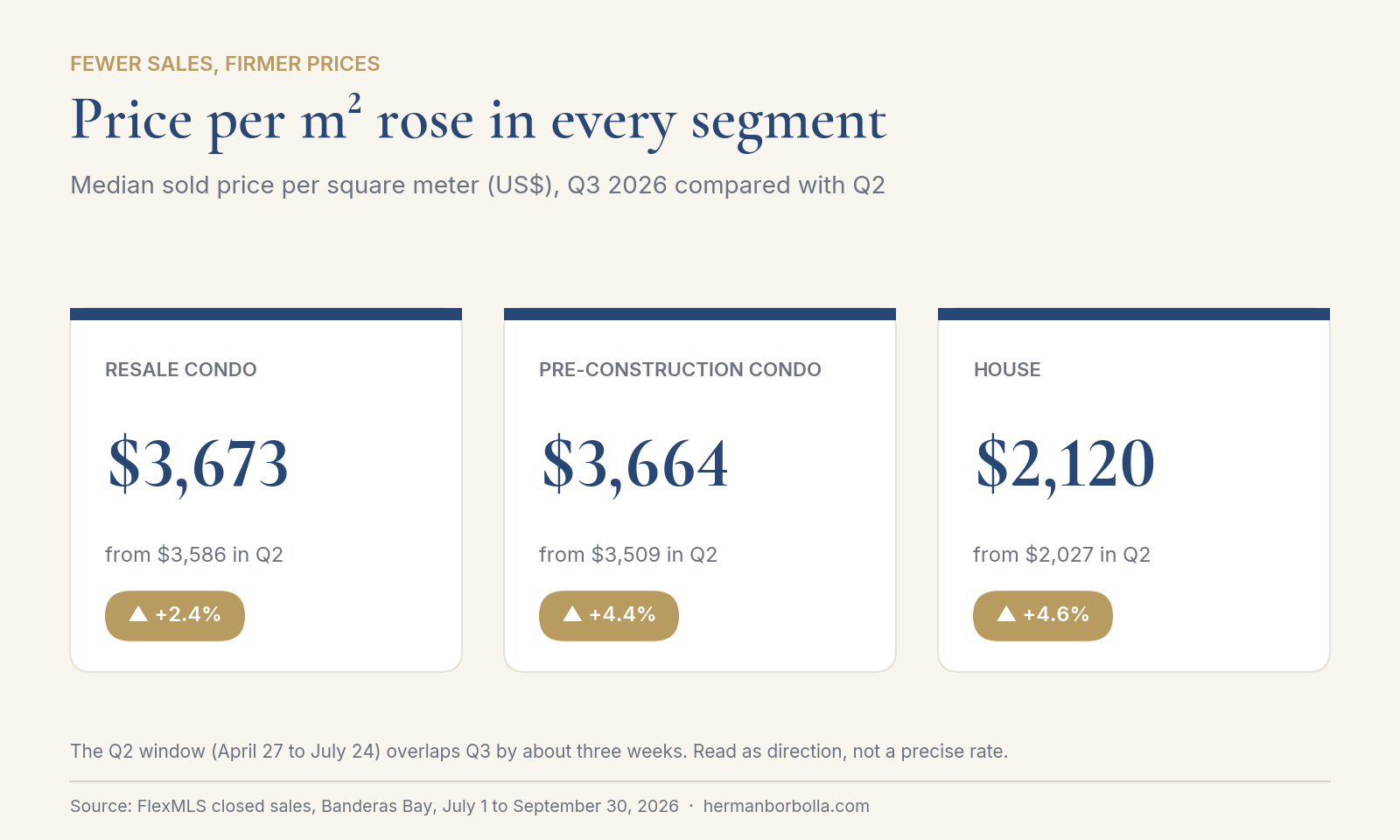
The two report windows overlap by about three weeks, so read this as a direction, not a precise rate.
Who this costs: the buyer waiting for a slow season to bring prices down. This one brought fewer sales, not lower prices.
1. A house gets you 80 more square meters for the same $400,000
In plain terms: a meter of house costs a little more than half what a meter of condo costs.
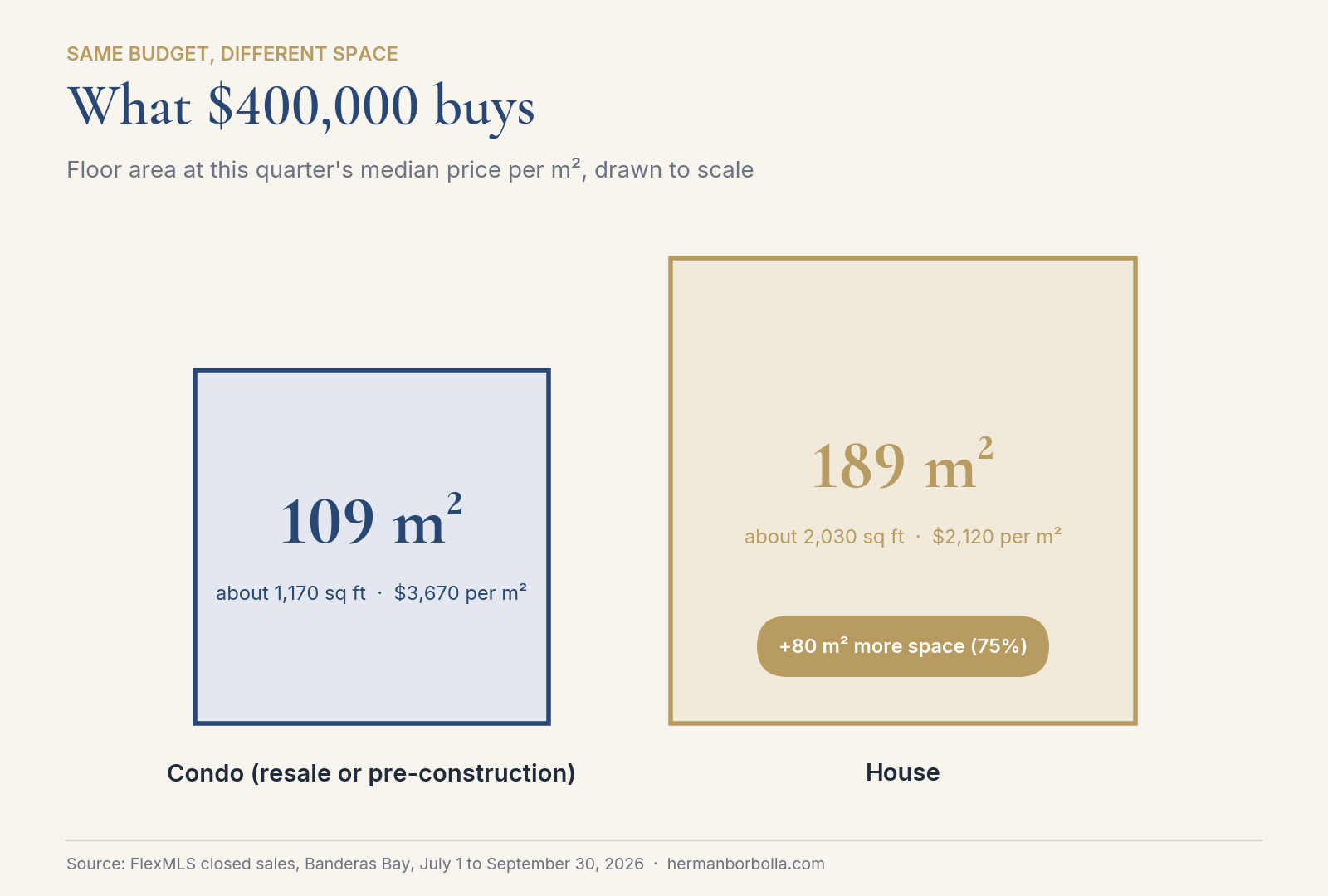
That is about 75% more space. Houses closed at 58% of the condo price per meter. Last quarter, 57%. This is how this market prices space.
Why the gap exists. A condo price includes what you share: the pool, the gym, the elevator, security, building upkeep, and often a rental program that earns while you are away. A house price is mostly land, walls and roof. You pay less per meter and take on the upkeep yourself.
What it means for you. If you want to lock and leave, with amenities and rental income, the condo premium buys something real. If you will live here most of the year, ask whether you will use a shared pool more than 80 square meters of your own: a guest room for the people who visit, a terrace you actually live on, a kitchen big enough to cook for friends.
Who this costs: the buyer who wanted a house life and negotiated their way, one tour at a time, into a smaller condo. It is the most common regret I see.
2. Pre-construction is still not cheaper
In plain terms: pre-construction means buying from the developer before the building is finished. You have probably been told it saves you 20 to 30%. This quarter it saved you $9 per square meter.
Pre-construction closed at a median of $3,664 per m². Resale closed at $3,673. Last quarter the gap was 2%. Twice now, the discount is effectively zero.
On paper, developers hold their price and individual sellers give ground.
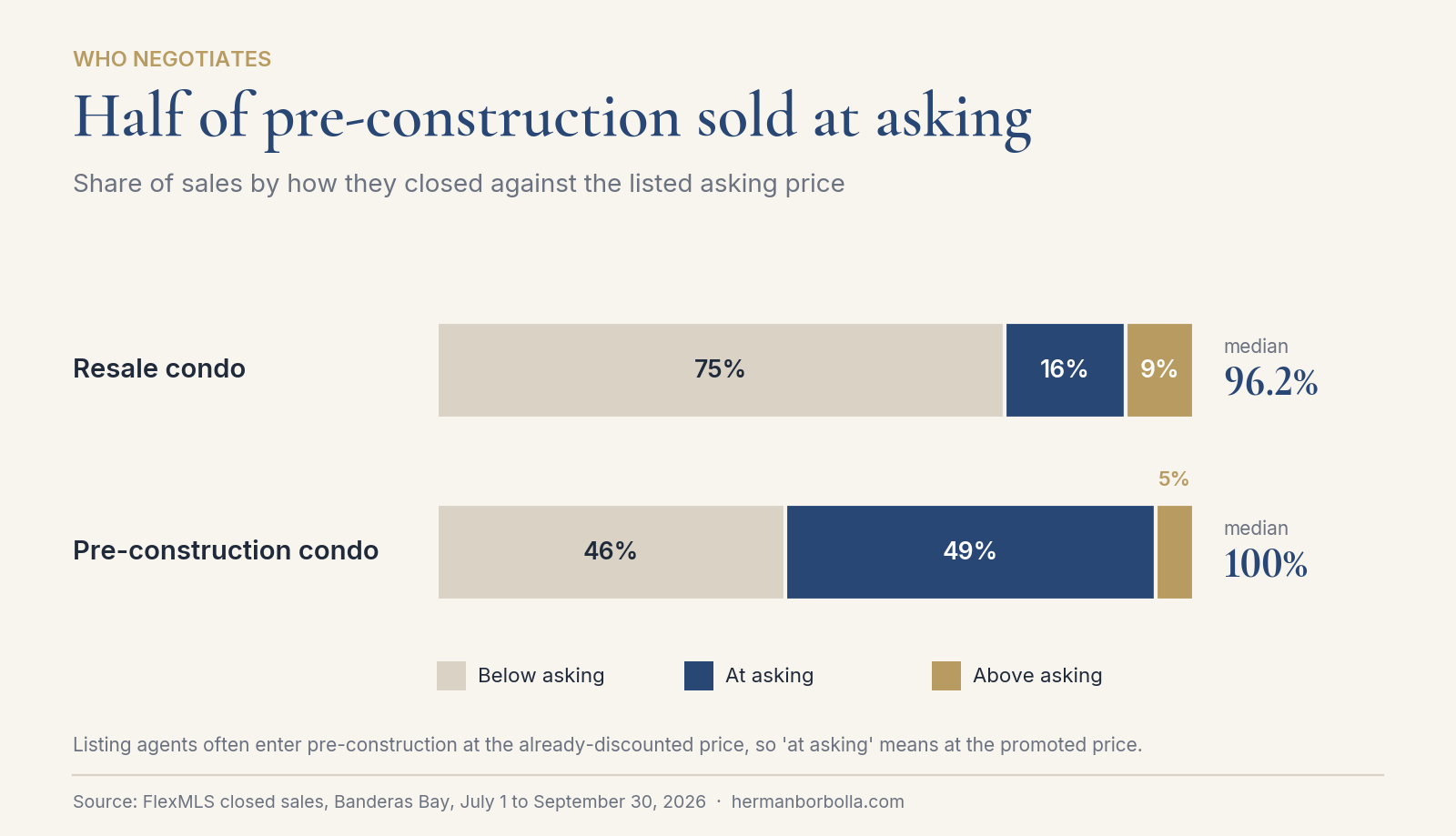
What changed: last quarter, one in four pre-construction units closed above its asking price. This quarter, 2 of 41. Developers are still closing at their listed price. They have stopped pushing past it.
The discount that was never a discount. FlexMLS rules now require listing agents to enter pre-construction units at the full price, before any promotional discount. In practice, most listing agents still enter the already-discounted price in the listing price field. That is why so many units close at exactly the asking price: the negotiation happened in the brochure, not at the table.
And that discounted price lands almost exactly on the price per meter of a finished resale condo: $3,664 against $3,673 this quarter. Put plainly, the brochure price is set high so that a 20% or 30% "discount" brings it down to the price the seller always expected to get. The discount is the marketing. The closing price is the market.
Supermarkets and department stores do the same with "was" and "now" tags. Most industries do it. That does not make it right, and in a purchase this size it costs the buyer something real: the belief that they bought below value, when they paid market price.
How to check it yourself. Ignore the discount percentage. Divide the price you would actually pay by the unit's built square meters, and compare that number with recent resale closings in the same area. If they match, you are paying market price, whatever the brochure says.
One more number needs context. A developer's asking price moves up in steps as a project sells. That is why 13 of the 41 units (about one in three) closed above the developer's first listed price, even though only 2 beat the latest one. Six of those 13 were in La Cruz de Huanacaxtle.
What it means for you. There are good reasons to buy pre-construction: you pay in stages while it is built, you can choose the finishes of the home you will live in, you get a new-build warranty, and you get into buildings that will not have resale units for years. A discount is not one of them.
Who this costs: the buyer who chose pre-construction for a discount and gave up a finished home they could have moved into now. If someone sells you pre-construction on price, ask to see the closed numbers.
3. The first asking price is an opening position
In plain terms: a seller picks a number on day one. Time passes, the price may get cut, then a buyer negotiates. The question is how far apart the first number and the final number end up.
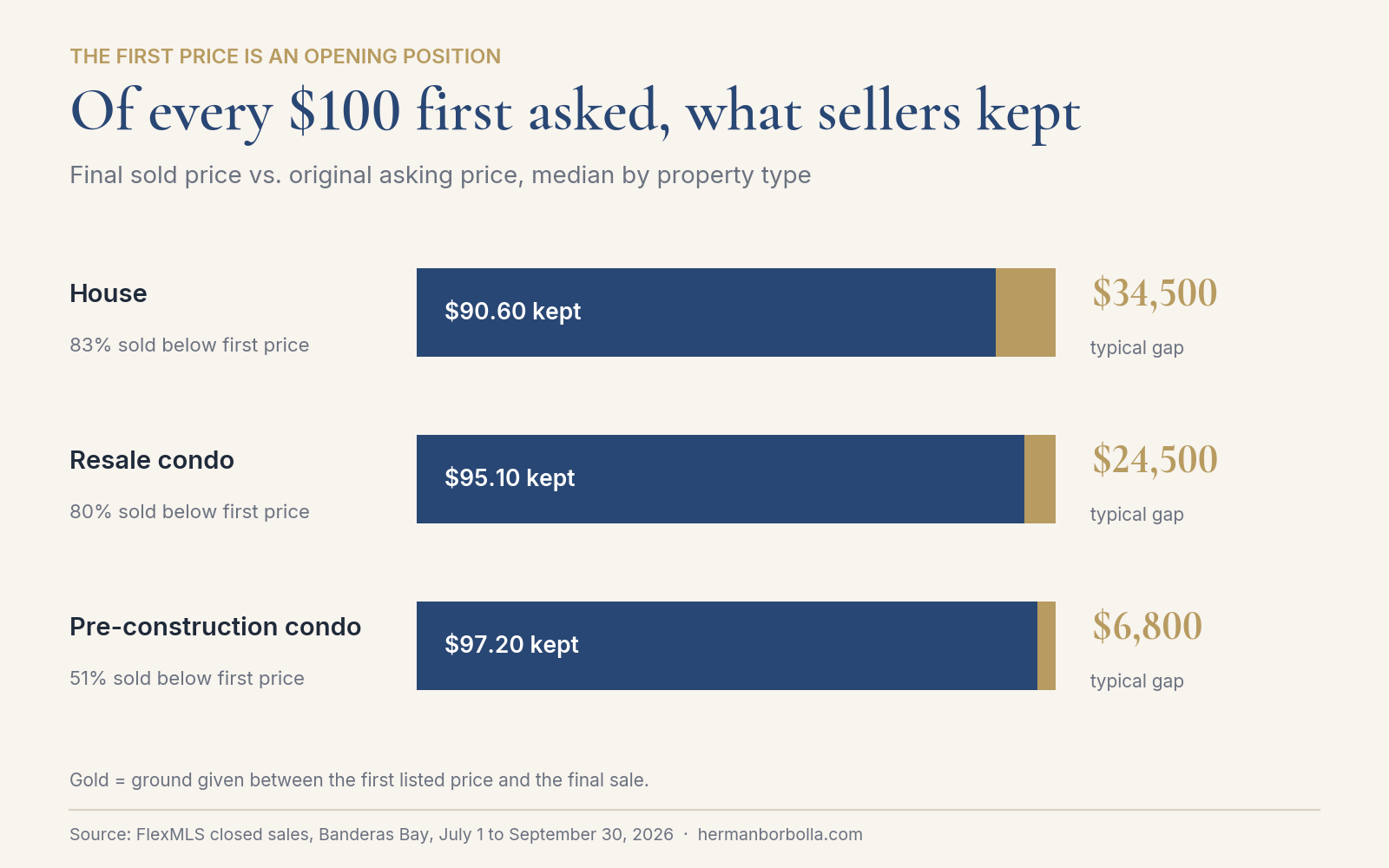
House sellers kept about 91 cents of every dollar they first asked. Across all houses, the typical gap was $34,500. Among the 83% that came down, the typical cut was $49,000. Before the final negotiation, 43% of houses had already cut their asking price.
The largest gap in dollars this quarter: a house in Centro North, first listed at $4.695 million, sold for $2.75 million after 660 days on the market.
Time on the market tells the same story. The typical house sold after 229 days and the typical resale condo after 195. Pre-construction shows 351 days, which looks alarming and is not. Developers list units while the building goes up, and 19 of these 41 had been listed for more than a year. That number measures how long the project has been selling, not how hard the unit was to sell.
What it means for you. If you are buying, the listing price is where the conversation starts. How long a home has waited, and whether its price has been cut, tells you how much room there may be. If you are selling, an ambitious first price does not protect your value. The market corrects it, usually slowly, and a stale listing invites lower offers.
Who this costs: the seller who started high to leave room for negotiation. The market took the room and added months.
4. Above $1.5 million, houses give more ground than condos
In plain terms: above $1 million there are few sales each quarter. This quarter, 29. With numbers that small, one unusual sale can move the result, so read this as a direction, not a rule. Every number is shown as it stands.
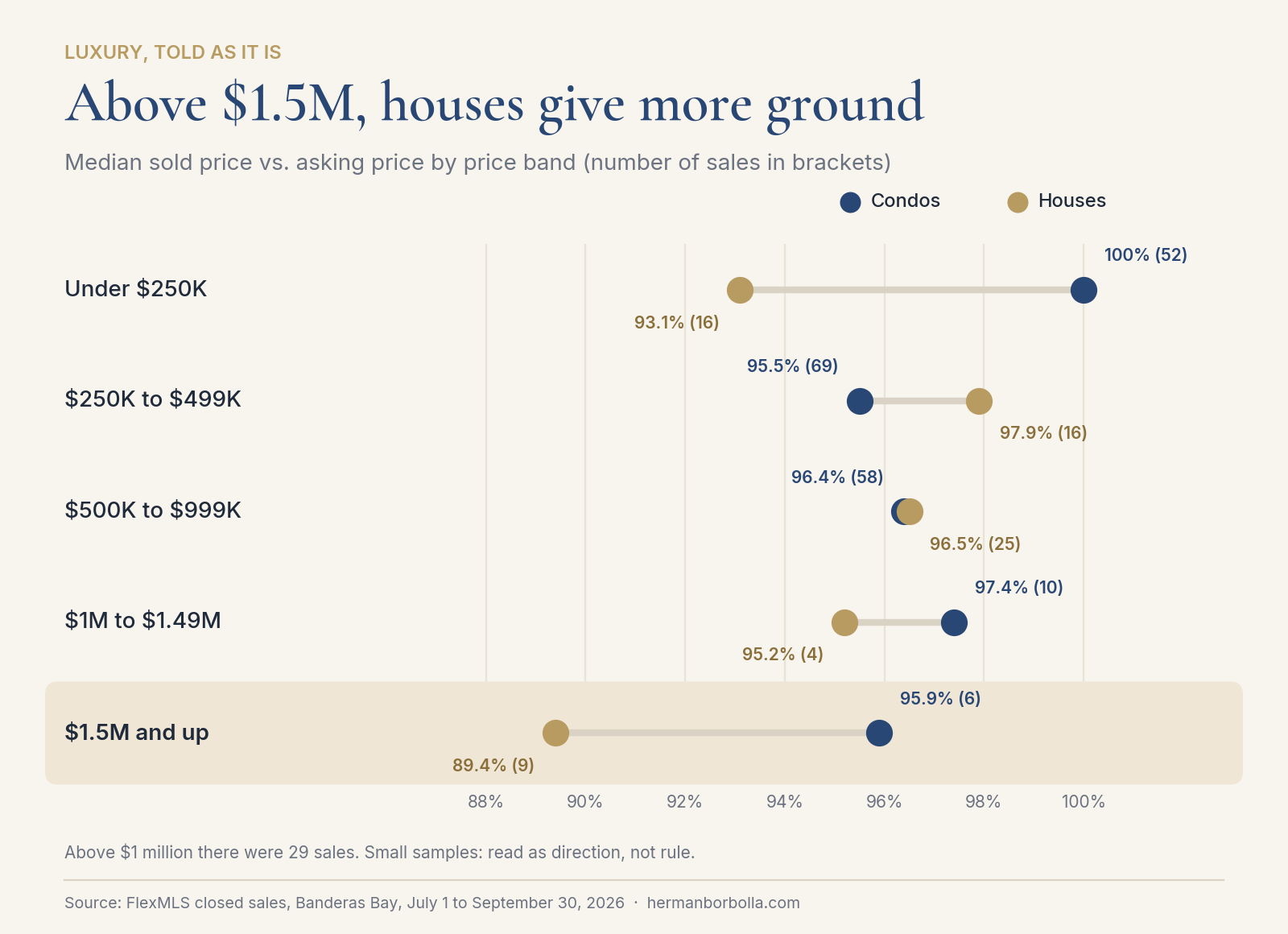
At $1.5 million and up, houses sold at 89% of asking and condos at 96%. The typical house at that level sold for about $2.5 million, so that gap is roughly $160,000 of room a comparable condo seller did not give.
Last quarter the gap was far wider: houses closed at 78% of asking between $1 million and $1.5 million, and 86% above that. This quarter, 95% and 89%. With 13 house sales above $1 million, I cannot tell you whether that is a real shift or simply which homes happened to sell. What held is the direction.
Why. A $2.5 million house waits for one specific buyer, someone who walks in and recognises their life in it, and there are few of them at any moment. A high-end condo in a known building has more interchangeable buyers, so its seller can wait. House sellers at this level are also more often moving for life reasons (relocation, inheritance, a change in plans) than condo investors defending a return.
What it means for you. At this level, a house and a condo at the same price are not the same negotiation. House buyers should expect more room. House sellers should price realistically from day one, because the market tests that number harder than it tests a condo's.
Who this costs: the house seller at this level who prices like a condo seller.
What I would tell a client this quarter
None of these numbers should make a decision for you. They should inform it.
If you want amenities and rental income, the condo premium is worth paying.
If you want a new build for its timing or its finishes, buy pre-construction. Just do not expect a discount.
If you are looking at houses, read the days on market and the price history before you make an offer.
If you are selling, your first price is the number the market will test hardest. Set it as if it will be tested.
Most agents need you to decide. I need you to be certain. If one of these numbers sits under a decision you are weighing right now, that is the conversation worth having.
The next report publishes Tuesday, January 5, 2027.
Four terms used in this report
Price per square meter (m²). The sale price divided by the built space. It is the fairest way to compare a small condo with a large house. One square meter is about 10.8 square feet.
Asking price vs. sold price. The asking price is what the seller wanted. The sold price is what the buyer paid. A sale at 95% of asking means the buyer paid $95 for every $100 the seller asked.
First (original) asking price. The very first price on the listing. Many sellers lower it while the property sits on the market. Comparing the first price with the final one shows how much ground sellers really gave.
Median. The middle sale when you line them all up from cheapest to most expensive. I use it instead of the average because one $4 million villa would pull an average up and distort the picture.
Methodology
Data source: FlexMLS, Vallarta-Nayarit MLS closed transaction records, sold dates July 1 to September 30, 2026, Jalisco and Nayarit. Sample: 265 residential sales (154 resale condos, 41 pre-construction condos, 70 houses). One house in Ajijic, Lake Chapala, was excluded as outside the Banderas Bay market. The sample includes 4 sales north of San Pancho (Guayabitos, Chacala and the northern Nayarit coast). All figures in US dollars, as recorded in the FlexMLS USD price fields. Price per m² uses total built area. Sold-vs-asking ratios use the last list price; first-price comparisons use the original list price. "At the asking price" means within $1 of it. Medians are used throughout. Data reflects closings recorded in the MLS as of October 1, 2026; sales entered later are not included, which mostly affects September.
Reports follow calendar quarters from Q3 onward. The Q2 report covered April 27 to July 24, so the two windows overlap by about three weeks. Quarter-to-quarter comparisons are directional.
Statistical analysis derived from FlexMLS closed transaction records, distinct from Herman Borbolla's local market knowledge, accumulated through residence and observation since 2007 and active professional practice since 2021.
The Monthly Briefing
Once a month. The things worth knowing.
A short, monthly read on what’s actually moving in Banderas Bay: market shifts, a neighbourhood worth watching, the occasional thing I’d tell a client before it reaches a listing. No noise, no selling. If a month has nothing worth your time, I don’t send one.
Weighing a pre-construction project right now? the three questions I check before any renderings matter are the place to start.