There is a moment inside a pre-construction sales gallery that most buyers in this market will recognise. The rendering is on the wall. The scale model is on the table. The agent is explaining the finishes. Somewhere behind the conversation, a quiet calculation is happening. Would this be the place. Could this be the decision.
The moment is real. The market it is happening inside is changing.
Over the last five years, four housing markets around the world have moved through the same cycle Puerto Vallarta is now inside. Costa del Sol. Dubai. Miami. Bali. Each of them saw pre-construction inventory rise faster than absorption. Each of them saw transaction volumes turn before prices did. Each of them, eventually, corrected. Some quickly, some slowly, some more painfully than others.
Puerto Vallarta is not any of those markets. But the signals those markets showed twelve to twenty-four months before their corrections are signals that are readable, and some of them are now readable here.
This is a piece about what the data is saying, quietly, if you know where to look.
Here is the finding, stated plainly, before the four-market tour that explains it. Puerto Vallarta's pre-construction condominium market peaked in 2022 at 1,121 closed transactions across the Banderas Bay corridor. By 2024 that number had fallen to 421, a decline of 62 percent from the peak. 2025 recovered only partially, to 592. Meanwhile, more than fifteen hundred pre-construction units now sit active in the corridor, with over eight hundred entering the market in 2025 alone. Four other coastal markets (Spain's Costa del Sol, Dubai, Miami, and Bali) moved through a similar shape before their own corrections: transaction volume turned down twelve to twenty-four months before asking prices did. Puerto Vallarta is not those markets. But some of the same signals are now readable here. What follows is the evidence, market by market, and what it means for a buyer deciding whether, and how, to enter this cycle.
A note on the data
The analysis that follows is drawn from FlexMLS, the shared listing database used by AMPI-affiliated brokerages and agents in the Banderas Bay corridor, filtered for condominium transactions and active listings from January 2021 through July 30, 2026, with the pre-construction segment isolated using the FlexMLS pre-construction status flag. A fuller note on methodology, and on the honest limits of any market database populated by many hands, sits at the end of this piece.
Four markets, one pattern
Housing markets do not correct on a single trigger. They correct on a sequence, and the sequence tends to look similar wherever it happens. Understanding the sequence is the point of the next four sections.
Spain, Costa del Sol and Costa Blanca: what happens when foreign confidence doesn't return
When foreign confidence in a market breaks, it does not reset within a cycle. It resets across a generation. Between 2006 and 2014, the Spanish coastal market moved through a full pre-construction cycle, built almost entirely on foreign buyers. British buyers alone accounted for thirty-eight percent of all foreign property purchases in Spain in 2008. By 2024, that share had fallen to just over eight percent. The buyers did not return in the same numbers after the correction. They returned in different numbers, on different terms, into a different market.
Dubai: the signal that arrives in volume, a year before it arrives in price
Volume is the leading indicator. Price is the lagging one. Dubai's off-plan market has corrected twice in the last twenty years: once sharply, in 2008 to 2010, and once slowly, in 2014 to 2018, and both corrections showed the same signal. In each cycle, transaction volumes turned down while asking prices were still climbing. Sellers were still asking more. Buyers were quietly agreeing to less. The gap between the two closed later, in price, but it opened first in volume. A market that reads asking prices alone is reading the story a year late.
Bali: when undifferentiated inventory becomes the inventory that discounts first
In every correction studied, architectural differentiation has been a form of downside protection. Undifferentiated inventory is the inventory that discounts first. The Canggu and Uluwatu villa market has spent the last three years absorbing an aggressive wave of boutique pre-construction development, and what emerged was not a single crisis but a slower problem: inventory converged aesthetically. Renders began to blur into each other. The same rooftop pool, the same jungle-facing terrace, the same beige-and-timber material palette, repeated across projects sold as distinctive.
Miami: the deposit structure that decided how the correction felt
Structure, not sentiment, is what makes a pre-construction market resilient. Miami is the market most familiar to the readers of this piece, and it is worth spending a little longer on. Downtown Miami's condo pre-construction market in the mid-2000s was roughly ninety percent foreign-buyer driven, with deposits typically at just ten percent. The transaction was structured around the assumption that the buyer would carry it to close. When the market turned in 2008, thousands of foreign buyers walked away from those deposits, calculating that a ten percent loss was cheaper than closing on a unit that had fallen thirty percent in value. Roughly twenty-two thousand condos were built through that cycle. Well over a thousand were still unsold five years later.
What Miami did next is the part worth remembering. When the market recovered, developers restructured the transaction. Deposits moved from ten percent to fifty percent or more, staged across construction milestones. That single change did more than any regulation could: it transformed the buyer's incentive from walk-away to see-it-through. When Miami slowed again in 2022 to 2024, the market cooled but did not crash. The high-deposit structure had absorbed the shock.
The shape they share
Four different markets, four different geographies, four different sets of buyers. Underneath, the same shape.
Foreign-buyer confidence withdraws before local buyers notice. Transaction volumes turn before asking prices do. Undifferentiated inventory begins to look like other undifferentiated inventory. And the markets that survive the correction with the least damage are the ones whose transaction structure protects the buyer's capital before the correction begins, not after it.
None of these signals arrive as a single moment. They arrive as a drift. The kind of drift that is only visible in aggregate, across many months, when someone is watching the whole market rather than any single project inside it.
Which brings us home. Puerto Vallarta is not Spain or Dubai or Bali or Miami. But some of the same signals those markets showed, twelve to twenty-four months before their corrections, are readable here now.
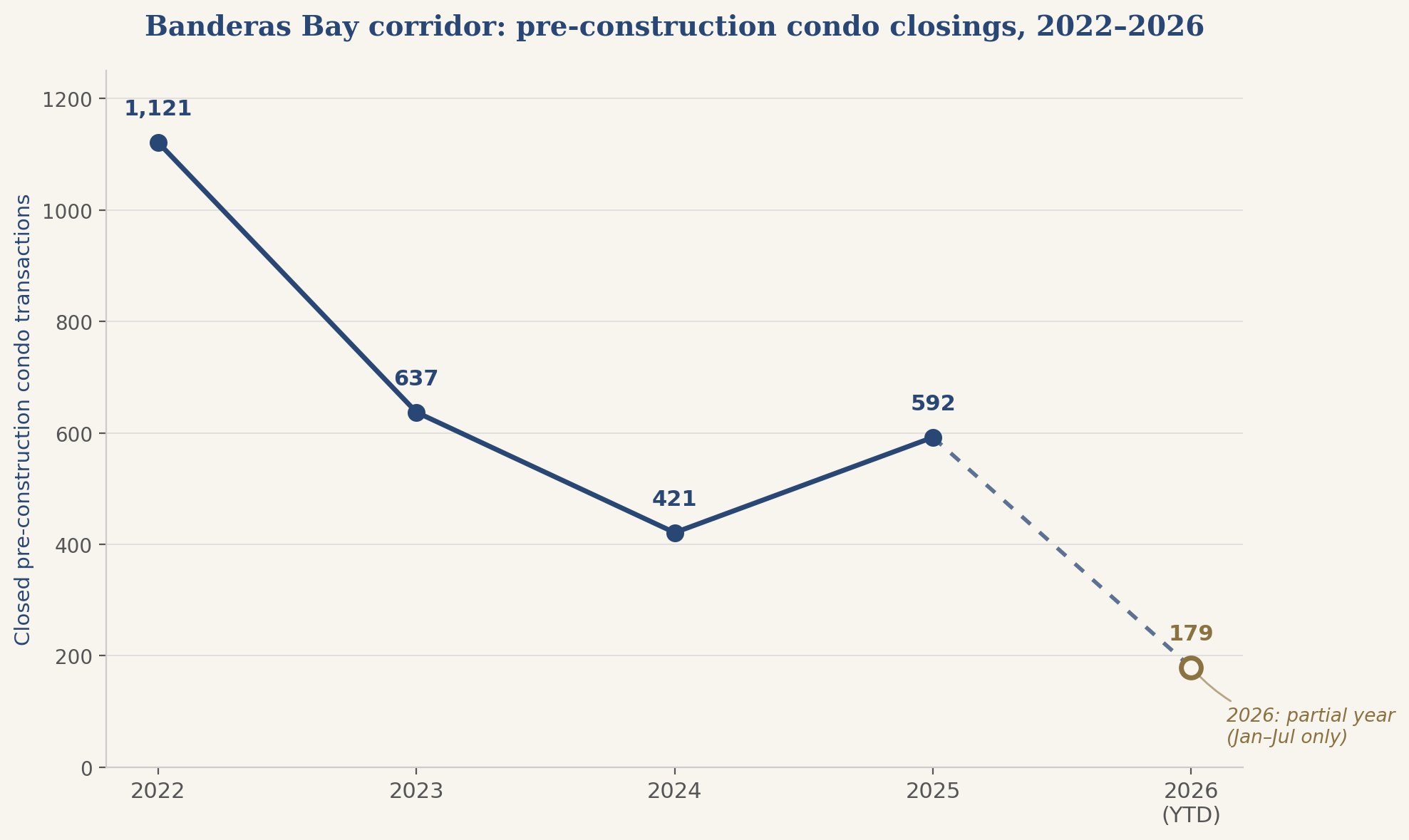
Line chart of closed pre-construction condominium transactions in the Banderas Bay corridor, 2022 through 2026 year-to-date, sourced from FlexMLS. Volume peaked at 1,121 in 2022 and fell to 421 by 2024, with the 2026 figure covering January through July only and shown as a partial year, not a full-year close.
What the data shows here
The Puerto Vallarta pre-construction condominium market moved through its peak in 2022. That year, one thousand one hundred and twenty-one pre-construction condo transactions closed across the Banderas Bay corridor. In 2023, that number fell to six hundred and thirty-seven, a decline of forty-three percent in a single year. In 2024, it fell again, to four hundred and twenty-one. In 2025, the market recovered partially, closing five hundred and ninety-two transactions. Through the first seven months of 2026, one hundred and seventy-nine pre-construction condos have closed. The volume trajectory is not ambiguous. Sales are running at roughly half their peak, three years on, and the recovery to date has been partial rather than complete.
The active side of the market tells the other half of the story. As of the end of July 2026, more than fifteen hundred pre-construction condominium units sit active in the corridor. Over eight hundred of them entered the MLS during 2025. Another three hundred and fifty entered in the first seven months of 2026. What is being built now is not being absorbed at the pace it is being brought to market. That is the definition, in any housing cycle, of an inventory build.
There is one more layer, and it is the layer that makes this market specific rather than generic.
Pre-construction in Mexico is not funded the way it is funded in Miami or Dubai. There is no mandatory pre-sale escrow. Buyer deposits, in most projects, are wired directly into the developer's operating account and become the working capital that funds the construction of the building the buyer has just committed to. It is not fraud and it is not bad practice. It is the standard structure of this market. It is also the structure that Miami restructured after 2008, that Dubai regulated after 2010, and that no market has yet restructured after seeing the same pattern twice.
There is a separate structural layer worth naming. Between 2021 and early 2024, federal authorities suspended twenty-two developments across Puerto Vallarta for environmental permitting issues. Frozen investment across those projects was reported at approximately three hundred and fifty-two million dollars. Several had already been sold to buyers. Those buyers waited two to three years for the negotiations to conclude, regardless of whose legal interpretation eventually prevailed. That episode is now closed. What it left behind is the reminder that a project's regulatory stack is not a background detail. It is the difference between a delivered unit and a decade of waiting.
None of this means the market is failing. It means the market is filtering. The buyers who navigate the next twenty-four months well will be the ones who understand what is being filtered, and why.
What this means for a buyer
A market that is filtering is not the same as a market that is failing. Filtering is a longer word for the same process by which every housing cycle eventually rewards the buyer who paid attention and disadvantages the buyer who did not. It is happening here now. It will keep happening for the next twenty-four months at least.
For someone who is not considering pre-construction, this analysis is a piece of context, no more. Resale in Banderas Bay is a different market with a different set of dynamics. Nothing above changes the fundamentals of buying a finished, delivered unit from a seller who owns it.
For someone who is considering pre-construction, this analysis is the reason the diligence matters more now than it did in 2021 or 2022. The gap between a well-run project and a poorly-run one has always been there. What has changed is that the market conditions no longer forgive the difference. In a rising market, a project with weak fundamentals can still deliver, still appreciate, still make the buyer whole. In a filtering market, weak fundamentals become the story of the purchase.
Some of the work of navigating this is teachable. Earlier this year I wrote a guide called The Calm Buyer's Guide to Pre-Construction, Puerto Vallarta 2026 Edition. It is the same conversation I have with clients before they sign anything, put on paper, so a buyer can have it with themselves first. It walks through the four conditions under which pre-construction is the right path for a specific buyer, the two documents that most protect a buyer's capital, and the three questions every buyer should ask a developer before wiring a deposit. It is on the site, free to download, whether we ever end up working together or not.
The four markets described earlier corrected on their own terms and their own timelines. Puerto Vallarta will do the same. What can be said, with the data currently readable, is that some of the signals those markets showed before their corrections are readable here now. Not all of them. Not yet.
That is not a reason to leave the market. It is a reason to enter it with better questions than most buyers arrive with. The buyers who navigate the next twenty-four months well will not be the ones who moved fastest or waited longest. They will be the ones who read the market carefully, chose the project deliberately, and negotiated the entry on terms that protected them if the market moved against them.
Paradise isn't found — it's negotiated.
Methodology and a note on the data
Every number in this piece is drawn from FlexMLS, the shared listing database used by AMPI-affiliated brokerages and agents in the Banderas Bay corridor. The pull covers condominium transactions and active listings from January 1, 2021, through July 30, 2026. The pre-construction segment was isolated using the FlexMLS pre-construction status flag.
FlexMLS is the most complete transaction record available in this market. It is also imperfect, and readers deserve to know how. It is populated by many hands, and the discipline with which each listing is entered varies by brokerage, by agent, and by moment. On one of my own pre-construction listings, I was instructed to enter the full price with no discount reflected. Other pre-construction listings for comparable projects show discounted prices as the list price. Both are inside the rules. Neither is wrong. But when you aggregate them, you are aggregating apples and slightly different apples. The same variability appears on the closing side, where not every agent records the actual net price with the same discipline.
I raise this not to discredit the data. The patterns discussed above are large enough that they survive the noise. But any number in this piece, mine or anyone else's, is a directional signal, not a certified transaction record.
One further note on scope. I have chosen not to name individual developments in this analysis. The purpose is to describe the shape of the market, not to evaluate specific projects. Project-level analysis, which draws on the same FlexMLS record along with visits, financial structure review, and developer track record research, is work I do privately for clients who are actively considering a purchase.
The filtering has already started. Which side of it a given project ends up on is usually visible before the market decides for everyone else, if you know where to look.
The Monthly Briefing
Once a month. The things worth knowing.
A short, monthly read on what’s actually moving in Banderas Bay: market shifts, a neighbourhood worth watching, the occasional thing I’d tell a client before it reaches a listing. No noise, no selling. If a month has nothing worth your time, I don’t send one.
If you're weighing a specific project against this shift: the three questions I check before any renderings matter are the place to start.