Puerto Vallarta Q2 2026: What the Closed Transaction Data Actually Shows
A data-anchored look at what actually happened in the Q2 2026 Banderas Bay market.
Most Puerto Vallarta real estate content is written from listings. This one is written from closings.
Between April 27 and July 24, 2026, the Vallarta-Nayarit MLS recorded 340 closed residential transactions across the Banderas Bay corridor. Together they represent approximately $174 million in transaction volume, split across three segments: 190 resale condos, 76 pre-construction condos, and 74 houses.
That dataset makes visible things that don't get discussed in marketing materials or agent conversations. Three of them are worth understanding whether you are buying, selling, or advising someone who is.
What follows is not a market forecast. It is what the money did.
1. The Efficiency Gap: Houses Trade at 57% of the Per-Meter Cost of Condos
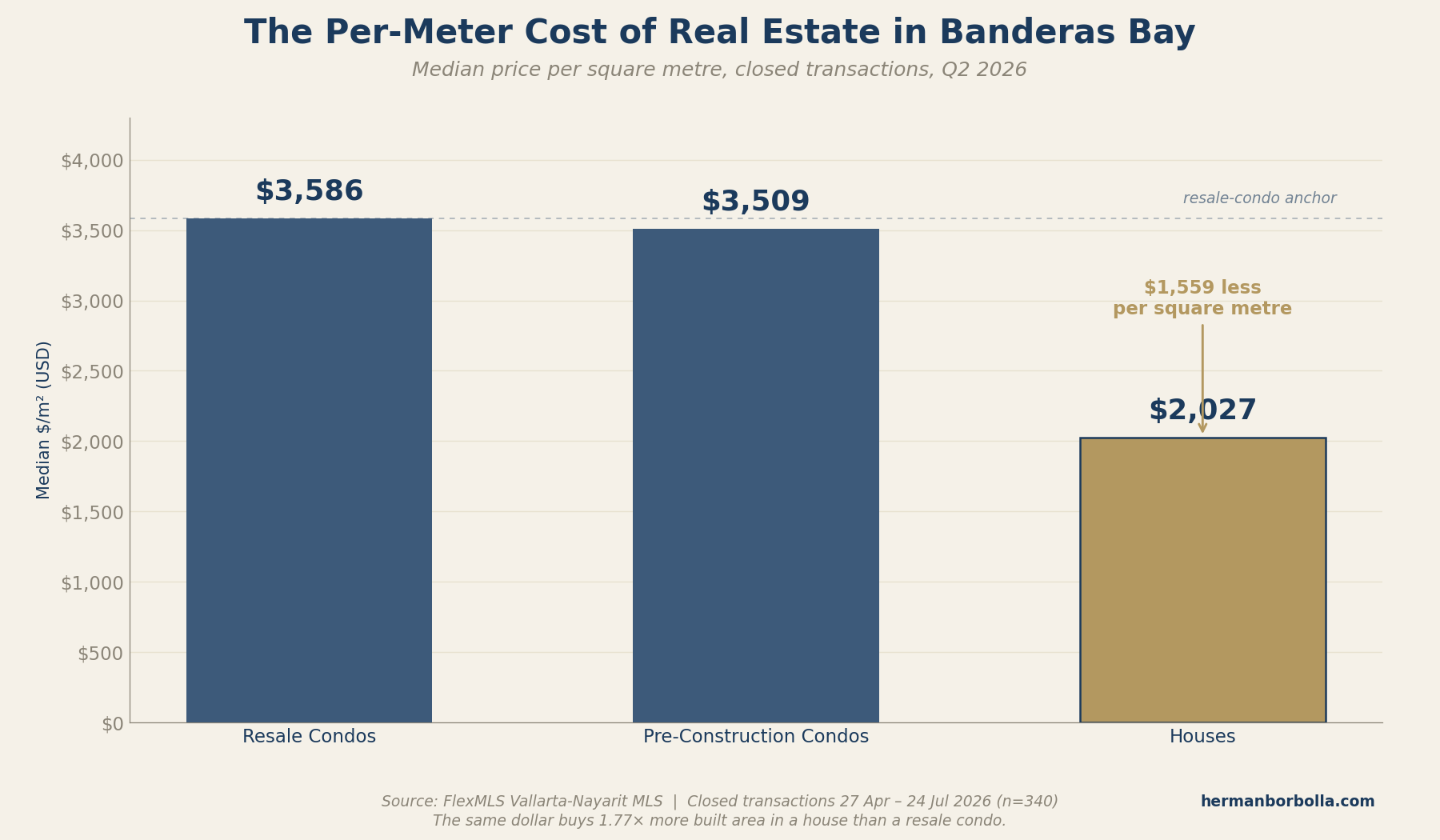
The single most consequential number in the Q2 data is $2,027.
That is the median price per square meter houses closed at across the 90-day window. The comparable figure for resale condos is $3,586. For pre-construction condos, $3,509.
In plain terms: houses in Banderas Bay are trading at roughly 57 percent of the per-meter cost of condos.
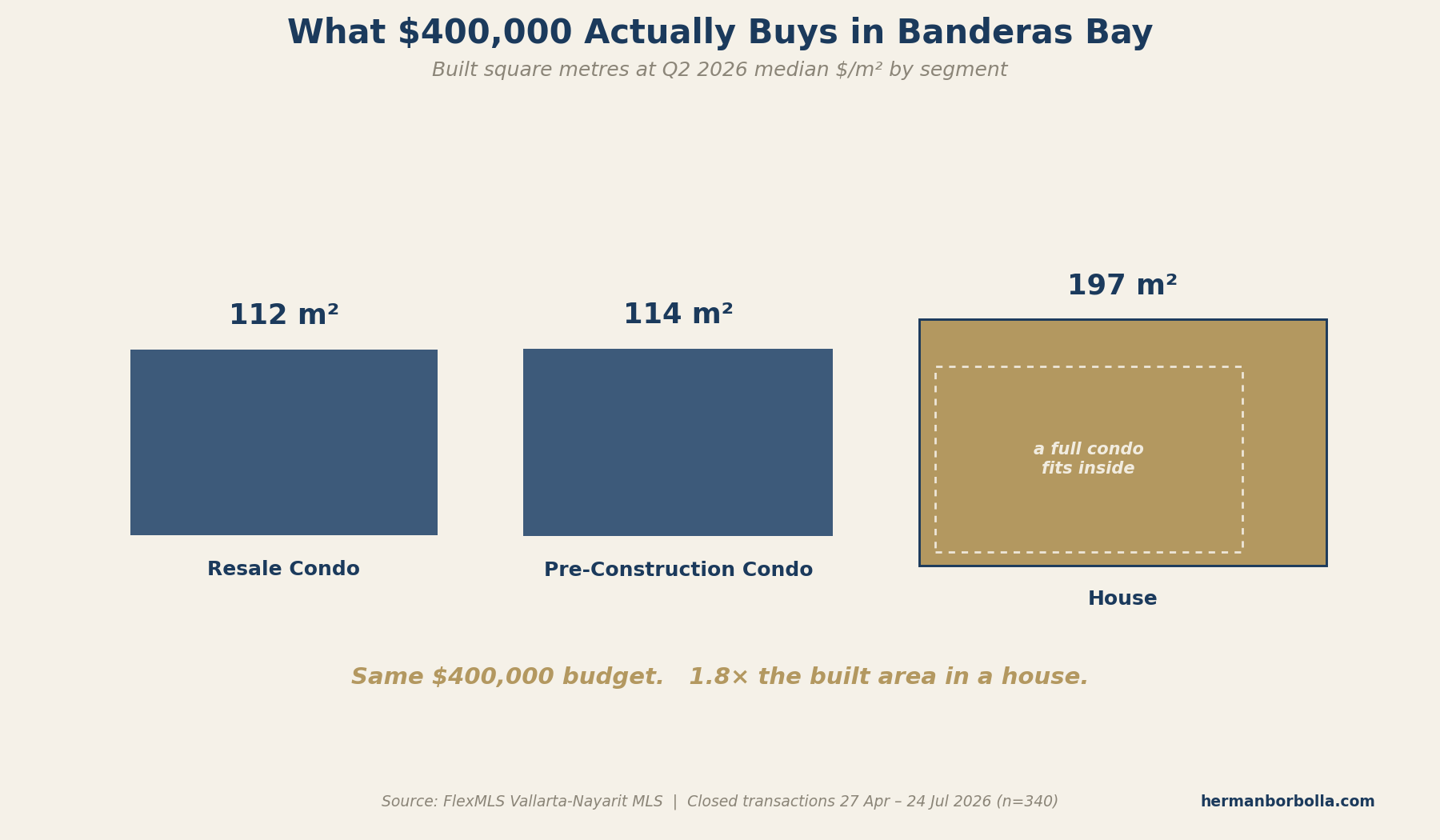
To translate that into the way most buyers actually think, consider a $400,000 budget:
A resale condo purchase gets you approximately 112 square meters of built space.
A pre-construction condo gets you 114 square meters.
A house gets you 197 square meters.
The delta is not marginal. It is nearly 1.8 times more built area for the same money.
There are structural reasons for the gap, and they are worth naming clearly. Condo pricing incorporates a premium for amenities (pools, gyms, doormen, elevators), for building infrastructure (structural engineering, common-area maintenance reserves), for the vertical-density economics that make ocean views possible, and for the rental-pool machinery that lets absentee owners generate income between visits. Houses carry none of these directly. What you pay for in a house is land, walls, and roof, plus the flexibility to configure them as you wish.
Whether the condo premium is worth paying depends entirely on what you plan to do with the property. For a buyer whose life is oriented around a lock-and-leave rental yield, or around the specific amenity stack of a branded tower, the premium is arguably the point. For a buyer building a primary residence, whose life will be lived inside the walls of the property rather than around a shared pool deck, the premium is a substantial and often unexamined cost.
The most common failure mode is buyers who conceptually want a house-based life and negotiate their way, one condo tour at a time, into a smaller property they feel constrained by within eighteen months.
2. Pre-Construction Is Not Cheaper Than Resale
The received wisdom in local buyer conversations is that pre-construction condos offer a meaningful discount to resale, typically framed as 20 to 30 percent off comparable finished inventory. The Q2 closed data does not support this claim.
Median price per square meter for pre-construction closings: $3,509. Median for resale condos: $3,586.
Pre-construction is trading approximately two percent below resale. In practical terms, the two are the same price.
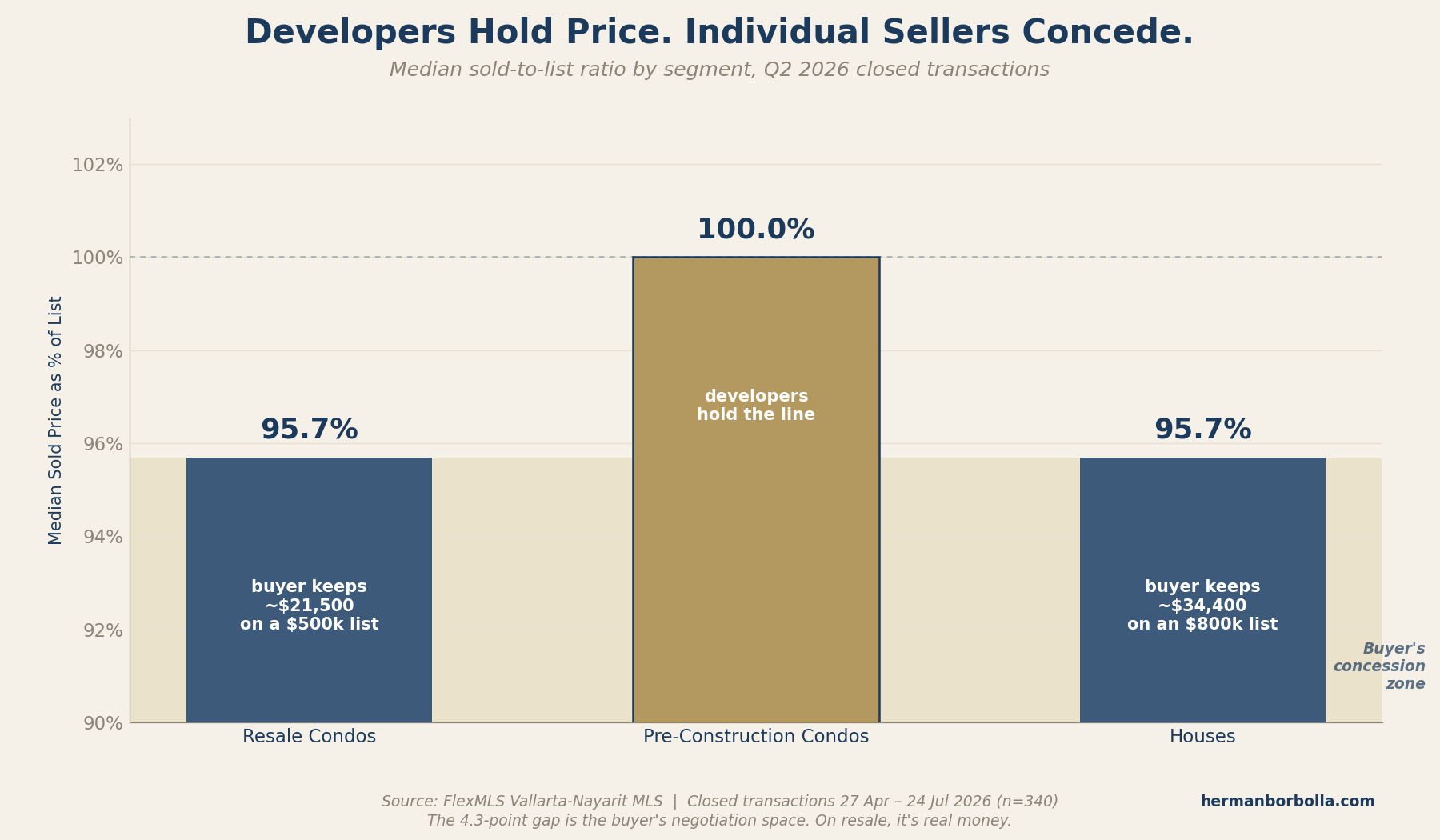
Where the segments diverge sharply is in negotiation behavior. The median resale condo closed at 95.7 percent of its most recent list price, and 78 percent of resale transactions closed below list. The median pre-construction condo closed at exactly 100 percent of list, and 25 percent closed above list.
Developers hold price. Individual sellers concede.
This is not because pre-construction is a stronger asset. It is because the pricing structure is fundamentally different. A developer running a project through sellout sets a price schedule that steps up at defined absorption thresholds. Buyers late in a sellout cycle pay the developer's stepped-up prices, not the introductory ones. The discount that circulates in agent conversations existed, but only for the earliest few units and only inside the developer's own pricing schedule. It is not available to a buyer walking in at 60 percent absorption.
What pre-construction buyers are actually paying for is not a discount. It is:
Future-dated delivery, which lets a buyer lock in a purchase now and pay it out across the construction period.
Design selection, when buying early enough in the sales cycle.
Developer warranty on new construction.
Access to inventory in buildings that will not have resale supply for years.
All four are legitimate reasons to buy pre-construction. None of them is a discount. Buyers who enter pre-construction expecting to save meaningfully on a per-meter basis are working from a premise the transaction data does not support.
One exception worth naming. In La Cruz de Huanacaxtle, the Q3 pre-construction $/m² was $4,356 against a resale $/m² of $3,252, a rare inversion where new construction is meaningfully more expensive than existing product. That is a specific and interesting story for another post.
3. Luxury Houses Are Negotiating Very Differently Than Luxury Condos
Sample sizes get thinner as you move up the price ladder, so this finding requires more caveats than the previous two. But the direction is stark enough to be worth naming.
Houses that sold in the $1 million to $1.5 million range closed at a median 78 percent of their list price. Houses above $1.5 million closed at 86 percent.
Condos in the same brackets closed at 94 percent.
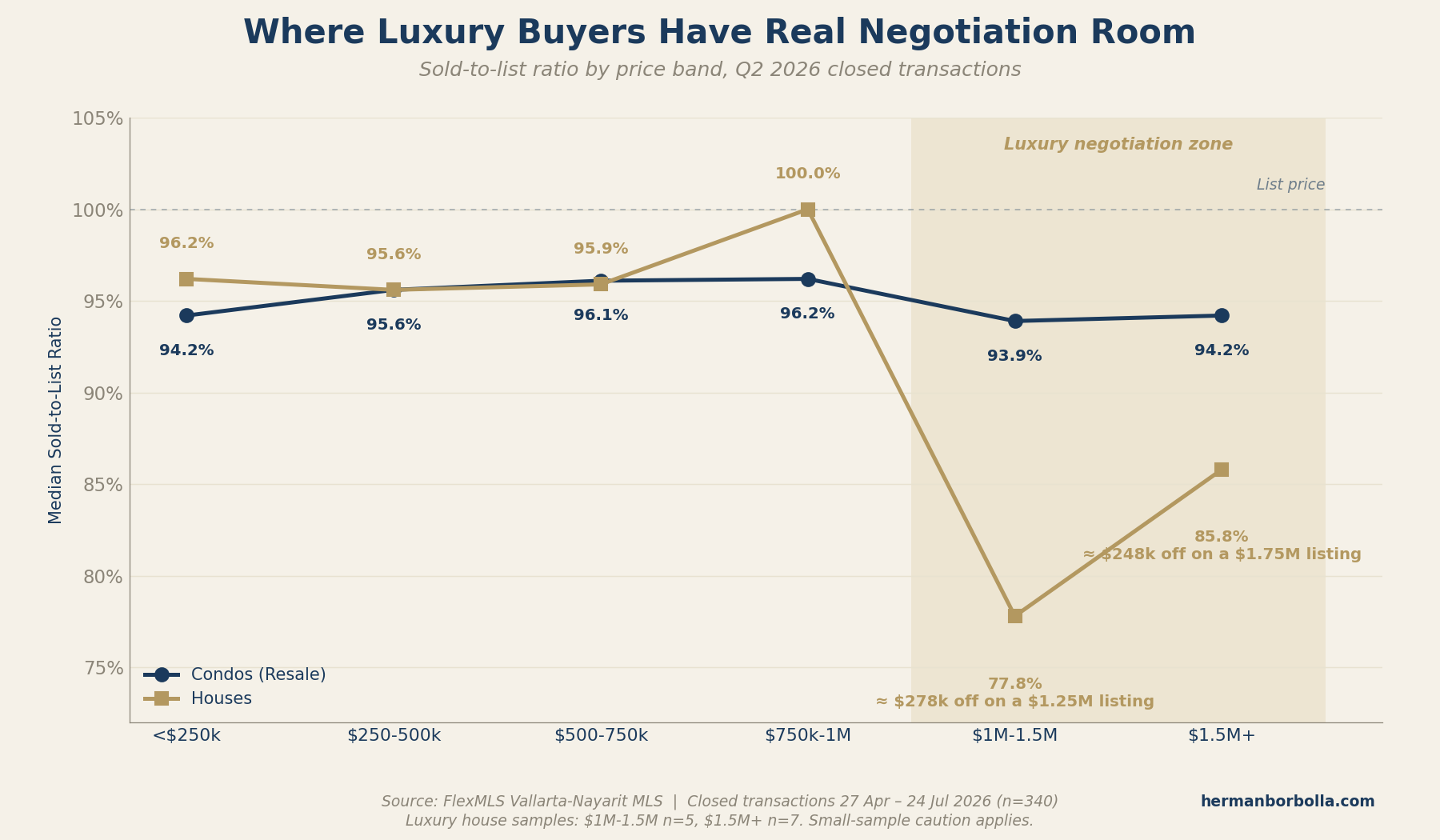
A 16 percentage-point spread in the sold-to-list ratio is not a marginal difference. It is the difference between a seller anchored to their ask and a seller whose listing has effectively been priced to be negotiated down. On a $1.2 million property, that spread represents roughly $95,000 of purchasing power the seller of a comparable condo is not conceding.
Two structural explanations sit behind the pattern.
First, luxury houses have thinner buyer pools than luxury condos. The buyer of a $1.5 million villa is a specific person with specific lifestyle requirements, and the seller cannot afford to wait for the next one to appear. Luxury condo buyers are more fungible: multiple parties may be considering the same building at any given moment, and sellers can hold price with more confidence.
Second, luxury house sellers are more likely to be individuals with life-event motivations (relocation, estate settlement, divorce, portfolio rebalancing) than luxury condo sellers, who are more likely to be investors defending return calculations.
For high-end buyers, the practical implication is clear enough. Comparable-quality houses and condos above $1 million are not comparable negotiations. If you are prepared to work in the house segment, you should expect and pursue substantially more room than the condo segment offers.
For high-end sellers, the reverse is true. Pricing a luxury house realistically at the outset is doing work that pricing a luxury condo does not require.
What This Actually Means
Three findings, briefly restated:
Houses trade at a large and underdiscussed per-meter discount to condos.
Pre-construction condos are not cheaper than resale condos in this market.
Luxury houses transact with materially more negotiation than luxury condos.
None of these should determine a decision. They should inform one.
A buyer whose life is oriented around amenities and rental yield is right to pay the condo premium. A buyer who wants pre-construction for delivery timing, design choice, or building access is right to buy pre-construction even without a per-meter discount. A luxury buyer who wants condo living should not switch to houses on the strength of a negotiation asymmetry that has structural reasons.
But the buyers I most often work with are people for whom these three findings materially change what they should be looking at, and how they should be approaching the transaction when they find it.
Most agents need you to decide. I need you to be certain.
Paradise isn't found — it's negotiated.
Methodology
Data source: FlexMLS Vallarta-Nayarit MLS closed transaction records, 27 April to 24 July 2026. Sample: 340 residential transactions comprising 190 resale condos, 76 pre-construction condos, and 74 houses. All monetary figures in US dollars. Median statistics used throughout to reduce distortion from outlier transactions. Sold-to-list ratios calculated against the most recent list price at time of sale.